
Walk into any cannabis shop in 2026 — licensed dispensary, online hemp shop, doesn’t matter — and look at the menu. You’ll see Gelato. You’ll see Runtz. You’ll see Lemon Cherry Gelato, Zushi, Sherbet, Gushers, Cake, every variation. Almost all of those strains share a common ancestor that didn’t exist before 2010.
Modern cannabis genetics didn’t drift toward “candy” by accident. It happened through a specific lineage that came out of the Bay Area and Los Angeles over roughly fifteen years. Here’s how the West Coast strain tree actually grew.
The pre-Cookies era: gas and skunk
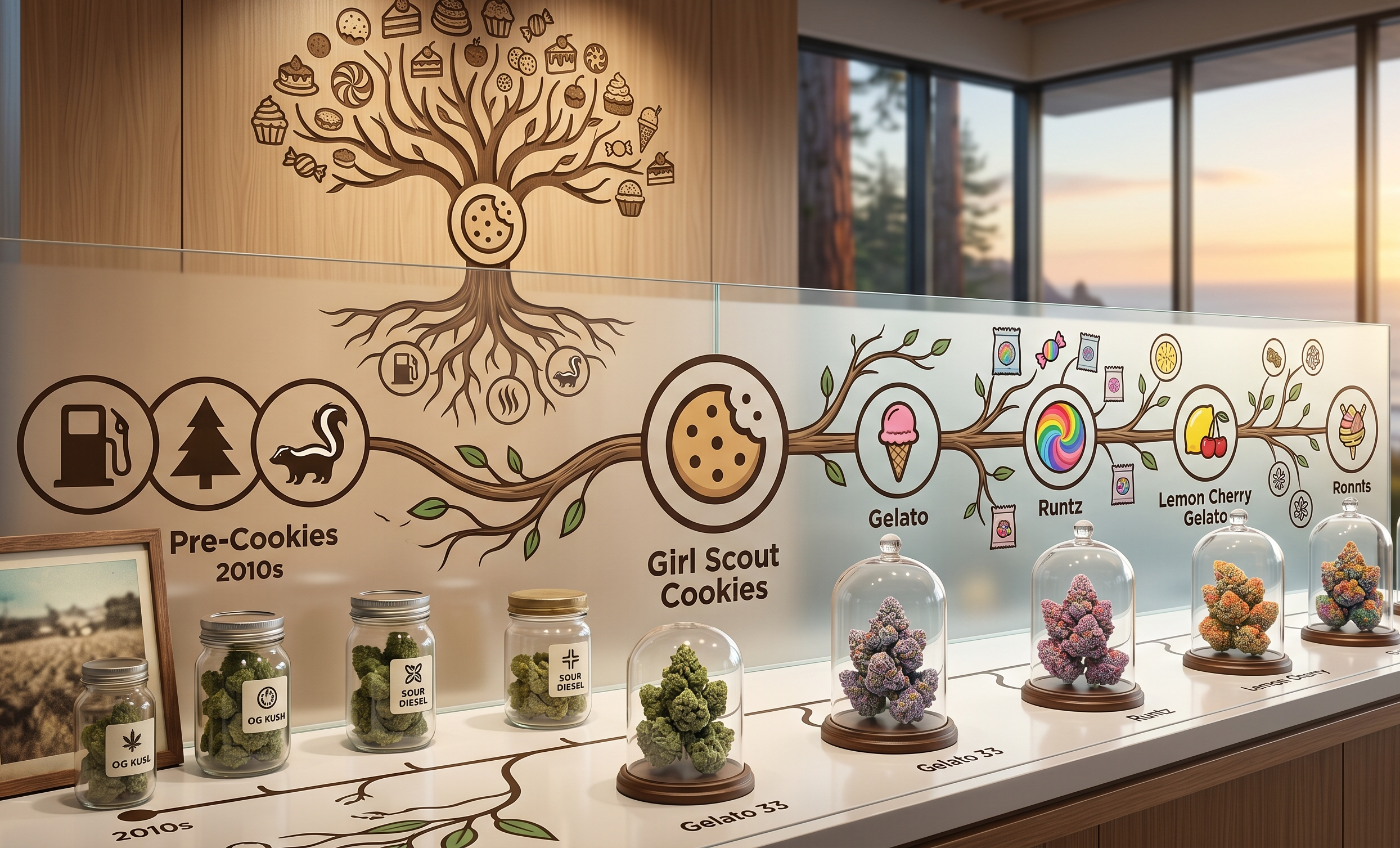
Before the early 2010s, the dominant flavor profiles in commercial cannabis were heavy on gas, skunk, pine, and earth. OG Kush and its phenotypes — SFV OG, Tahoe OG, Larry OG — dominated California. Sour Diesel held the East Coast. Chemdog, the parent of both of those, was the connective tissue.
These strains were potent, but they all lived in the same broad sensory neighborhood: pungent, fuel-forward, occasionally piney, occasionally skunky. The terpene profiles leaned on myrcene and caryophyllene with some pinene and humulene mixed in. They were good. They just all sort of smelled like cousins.
Then a different lineage broke into the open.
Girl Scout Cookies (2012) and the Cookies fam
Girl Scout Cookies — later renamed simply GSC for trademark reasons — appeared in the Bay Area around 2011-2012. The widely accepted genetics are a cross of OG Kush and Durban Poison, with possibly some F1 Durban Poison and Cherry Kush in the family tree depending on whose story you trust.
What GSC introduced that the OG strains didn’t have was a sweet, dessert-forward character on top of a still-pungent base. The Thin Mint and Forum cuts of GSC, in particular, were what set off the modern lineage. The Forum Cookies cut became the genetic mother of an entire generation of strains.
Cookies the brand (founded by Berner) commercialized this aesthetic and the lifestyle around it. The plant lineage and the brand are technically different things, but they grew up together and shaped each other.
Gelato (2014): the next generation
The single most influential cross of the 2010s was probably Gelato, made by crossing Thin Mint GSC with Sunset Sherbet. Gelato kept the dessert quality of Cookies but layered in creamier, fruitier notes from the Sherbet side.
Gelato also numbered its phenotypes — Gelato 33, Gelato 41, Gelato 45 — and each phenotype had a noticeably different profile. Gelato 33 (also called Larry Bird) became the most famous cut and the one most often crossed into the next generation.
This is the strain that really shifted the breeding world’s attention from “what’s the highest THC?” to “what’s the most distinctive terpene profile?”
Runtz (2017): when candy beat gas
In 2017, the Runtz crew — working out of Southern California in close orbit to the Cookies world — crossed Zkittlez with Gelato.
Zkittlez was already a fruit-forward strain (Grape Ape × Grapefruit lineage). Crossing it with Gelato pushed the resulting flower into territory nobody had quite seen at commercial scale: bright fruity sweetness on the inhale, creamy dessert finish, dense trichome coverage that made the buds look frosted. Runtz reportedly sold roughly five pounds in about ten minutes at Emerald Cup 2017 — a moment that the legacy market remembers as the point when candy strains officially eclipsed gas strains as the dominant aesthetic.
Runtz was named Leafly’s Strain of the Year in 2020, and by then the Runtz lineage had already spawned at least twenty named phenotypes: White Runtz, Pink Runtz, Black Runtz, Rainbow Runtz, Obama Runtz, and on and on. Money Bag Runtz, which we carry, sits inside this family.
Lemon Cherry Gelato, Zushi, and the modern era
Once Runtz hit, the breeding world started making crosses out of Runtz at a furious pace. A few of the most important offspring:
Lemon Cherry Gelato — bred by Berner’s Cookies. Sundae Driver × Lemon Cherry Punch is the most-cited lineage, though there’s some dispute. The strain leans hard on limonene and produces an unmistakable cherry-cola nose. It’s been one of the most-searched strains since 2022.
Zushi — a relative newcomer. The most commonly cited genetics are Zkittlez × Kush Mints, putting it inside the broader Cookies/Runtz orbit by way of Zkittlez. The profile is gas-forward with mint and sweet undertones, denser body effects than the candy-pure phenotypes.
Gushers — Gelato 41 × Triangle Kush. Fruity, gassy, dense.
Wedding Cake (Triangle Kush × Animal Mints) and Birthday Cake Kush brought the “cake” lineage into the mix. Wedding Cake then became a parent of countless modern hybrids.
Gumbo — multiple strains use this name, but the version most commonly seen in California traces to a Cookies-adjacent breeder. Sweet, balanced, dense.

The pattern by 2023–2024 was clear: the most commercially successful flower wasn’t necessarily the strongest by THC. It was the most expressive — the most distinctive nose, the most photogenic bud structure, the most memorable exhale.
Where it stands now
A few things are true about the West Coast lineage right now:
The “candy” era hasn’t ended, but gas is back. After several years of Runtz-family dominance, fuel-forward and OG-adjacent strains have crept back into the rotation. Strains like Bugatti OG (which we carry) and modern Sour Diesel cuts are getting attention again. The current taste seems to be for strains that bridge both worlds — sweet inhale, gas exhale.
Terpene profile beats THC percentage. A 22% flower with a clean, loud terpene profile will outsell a 28% flower with no nose. The market has finally caught up to what experienced consumers have been saying for a decade.
Genetics are getting protected. Cookies, Runtz, and a handful of other lineage holders have moved aggressively on trademarks and clone control. The “real” version of these strains is increasingly distinct from the seed-derived knockoffs that flood the market.
Phenotype variation matters more than people admit. Two batches of “Runtz” from different growers can taste like meaningfully different strains. The genetic name on the jar is a starting point, not a guarantee. This is why batch-specific COAs and consistent grower relationships actually matter.
What you’re really buying
When you pick up a jar of Lemon Cherry Gelato, Zushi, or Money Bag Runtz at West Coast Funk, you’re not just buying flower. You’re buying a specific point on a fifteen-year breeding tree that started with Cookies, branched through Gelato, exploded with Runtz, and is still being refined.
The candy era didn’t win because of marketing. It won because once breeders cracked the formula for layered, dessert-forward terpene profiles, the smell hit different and the experience stuck. That’s still the standard the West Coast holds itself to. The Funk lives in the lineage.