You spent real money on quality flower. The grower handled it right, the dry was slow, the cure was patient, the COA is clean. Then it gets to your house, and within a month it’s brittle, harsh, and smells like nothing.
That’s a storage problem. And it’s the part of the cannabis experience consumers control almost entirely on their own — but most people get wrong.
Here’s what’s actually happening to your flower while it sits there, and how to keep it the way it was when you opened the jar.
What degrades flower
Four enemies. They all work at once.
1. Oxygen
Oxidation is the slow chemical reaction that turns THC into CBN over time. CBN is fine, just different — it produces less of a head effect and more of a heavy, sedating one. So as your flower oxidizes, it’s not “losing strength” so much as shifting character. The lift fades and the heaviness creeps in. Old flower hits flatter for a reason.
2. Light, especially UV
A 1976 study (often cited as the Coffman and Gentner work) demonstrated that exposure to light is the single biggest factor in cannabinoid degradation. UV is especially damaging. Clear glass on a sunny shelf is the worst-case scenario.
3. Heat
Heat accelerates every degradation reaction happening to the flower. Above about 70°F (21°C), things start sliding faster. Above 86°F (30°C), they slide a lot faster. A hot car or a sunny windowsill will age flower in a weekend that should have lasted six months.
4. Humidity (in both directions)
Too dry and the flower becomes brittle, harsh-smoking, and the terpenes flash off. Too wet and you risk mold — including Aspergillus, which is genuinely dangerous to inhale. The sweet spot for cured flower storage is 58–62% relative humidity.
Where to keep it
The ideal storage environment:
- Cool — room temperature or slightly below, somewhere in the 60–70°F range.
- Dark — opaque container or stored in a closed cabinet/drawer.
- Dry-ish but not desert — 58–62% RH.
- Airtight — no air exchange with the room.
- Stable — not somewhere temperature swings wildly through the day.
Practical translation: a drawer in the bedroom is great. A kitchen counter is bad. The garage is worse. A car is a hard no.
What to keep it in
The container matters as much as the location.
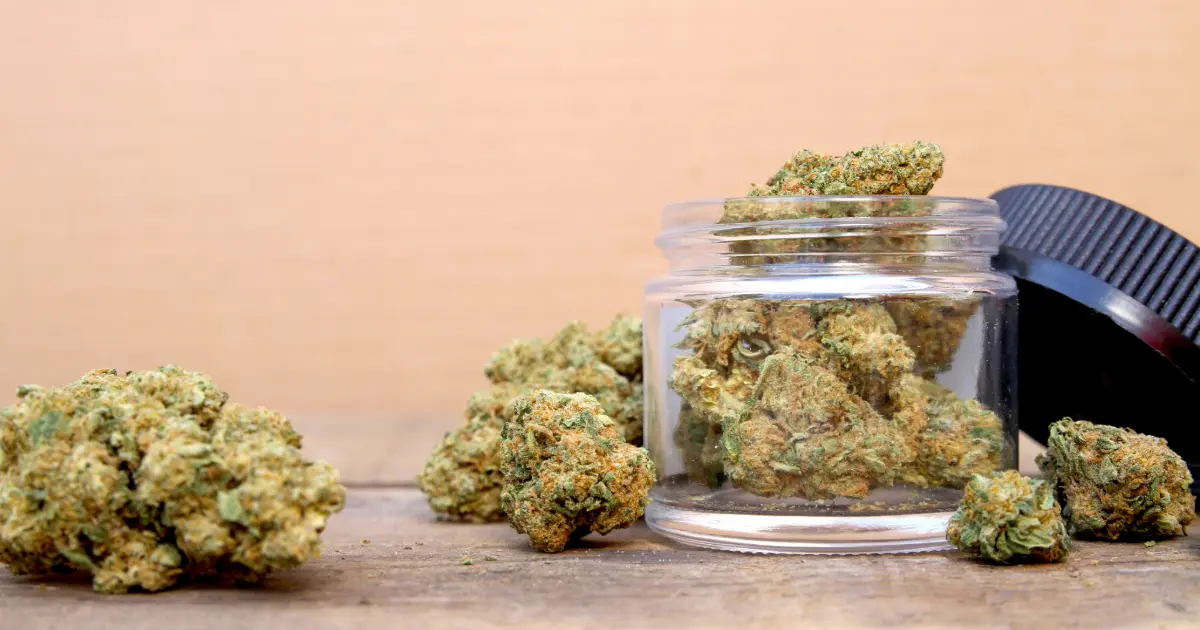
Best: glass jars with airtight seals
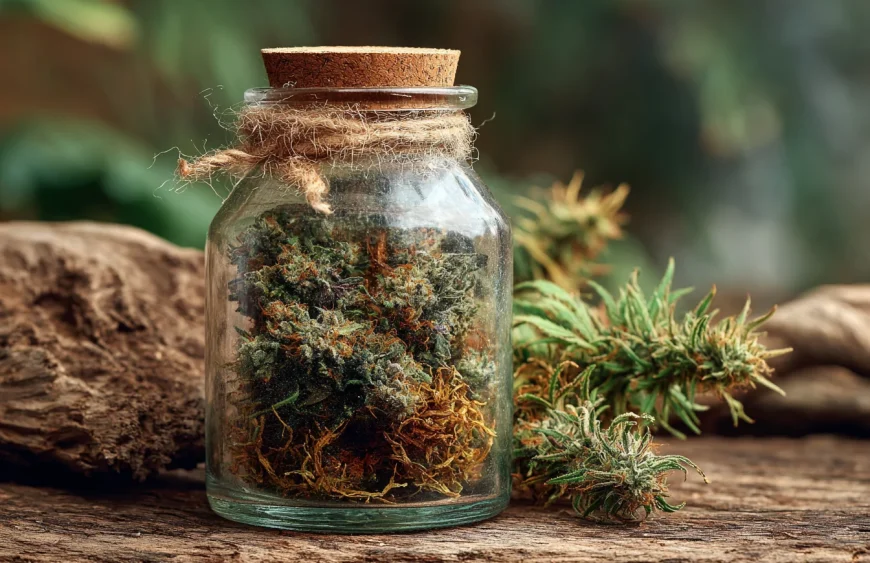
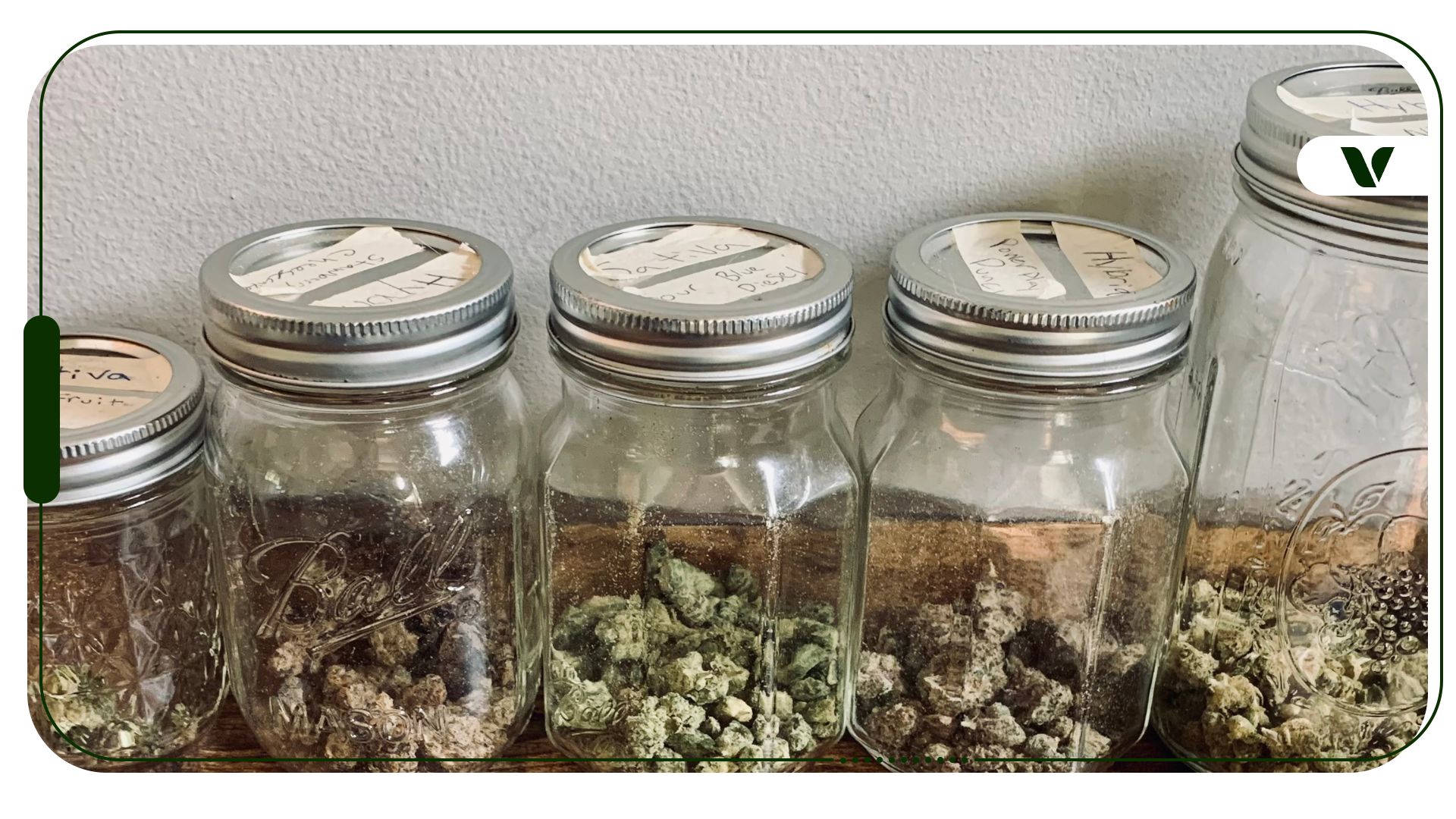
Mason jars, Miron violet glass, or any quality wide-mouth jar with a gasketed lid. Glass doesn’t off-gas, doesn’t react with the terpenes, doesn’t build a static charge, and seals reliably. Wide-mouth so you can get flower in and out without crushing it.
If you can, get opaque or UV-blocking glass. Miron glass is the gold-standard for this, but a clear jar inside a closed cabinet works fine too.
Good: food-grade sealed mylar bags
Mylar bags with a proper heat-seal or zip-lock work, especially for longer-term storage. They block light and limit air exchange. Less reusable than glass.
Acceptable: high-quality opaque plastic with a real seal
Some cannabis-specific containers (CVault is the most popular) use food-grade stainless steel with a humidity-pack-friendly interior. Works well.
Bad: cheap plastic bags
Static cling pulls trichomes off the flower. Plastic can also leach into the terpenes over time. If you bought your flower in a baggie, transfer it to a jar.
Worse: paper, cardboard, wood without a liner
Porous. They let air in, terpenes out, and absorb moisture inconsistently.
Humidity packs: yes, but with caveats
Boveda and Integra Boost are the two major brands of two-way humidity packs designed for cannabis. They release or absorb moisture to keep the container at a target RH — usually 58% or 62% for flower.
Use them. They genuinely work. A few rules:
- Don’t let the pack directly touch the flower. Some brands now make this safer, but in general the pack should sit on top of or beside the flower, not buried under it.
- Replace them when they go hard. A pliable pack is active. A crunchy pack is done.
- Match the size of the pack to the size of the container. Too small a pack in too big a jar means it’ll exhaust quickly.
- For long-term storage of larger amounts, you can stack multiple packs.
What about the fridge or freezer?
Fridges are a bad idea for flower. The humidity is unpredictable, the temperature cycles every time the door opens, and condensation is a real risk. Don’t.
The freezer is more controversial. For long-term storage of large quantities of fully cured, properly dried flower in a vacuum-sealed bag, freezing can preserve cannabinoids and terpenes for years. The risk is that frozen trichomes become brittle and can break off if the flower is handled while cold. If you freeze, freeze in serving-size portions, let them come back to room temperature fully before opening the bag (otherwise condensation forms inside), and don’t refreeze.
For most people storing a week’s or month’s worth of flower, a glass jar in a drawer beats the freezer every time.
Burping: what it is and when to do it
If you’ve bought a lot of flower at once and you’re storing the bulk for a while, “burping” the jar — opening it briefly to exchange air — is useful in the first couple of weeks to release excess moisture and prevent mold. Once a week, open the jar for thirty seconds, then reseal.
After about three weeks of storage with a humidity pack, burping isn’t really necessary. The pack is doing its job.
If your flower came from a brand that did its own proper cure (we do), the burping work is already done. You’re just maintaining what was delivered.
Realistic shelf life
With proper storage:
- 0–3 months: indistinguishable from fresh. Full terpene profile, full potency.
- 3–6 months: terpenes start to soften slightly. Most people won’t notice unless they’re comparing side by side.
- 6–12 months: the nose has clearly faded. Cannabinoids are still mostly there, but the experience feels flatter.
- 12+ months: THC has measurably converted to CBN. The flower still works, but it works differently.
With bad storage — hot car, plastic baggie, sunny shelf — you can hit the 12-month state in 30 days.
The short version
If you want to keep your flower the way it was when you opened it:
- Glass jar, airtight lid, somewhere dark and cool.
- A 58% or 62% humidity pack inside the jar.
- Don’t leave it in sunlight, don’t leave it in a hot car, don’t leave it in a plastic bag.
- Open the jar to use the flower, then close it.
That’s it. Cannabis is more durable than people assume but also more fragile than people treat it. Treat it like a good olive oil — cool, dark, sealed — and the jar you opened today will smell exactly the same six months from now.