You’ve probably seen the phrase “lab-tested” plastered across every cannabis brand on the internet. It’s basically table stakes at this point. The real question isn’t whether a product has been tested — it’s whether you know how to read the test when you see it.
That document is called a Certificate of Analysis, or COA. It’s the third-party lab report that tells you what’s actually inside the flower, vape, or concentrate you’re holding. Knowing how to read one is the difference between trusting a brand because their packaging looks nice and trusting a brand because the numbers check out.
Here’s how to actually read one.
What a COA is, in plain English
A COA is a report issued by an independent lab — meaning a lab that doesn’t belong to the brand selling the product. The brand sends a sample, the lab runs it through a series of tests, and the lab publishes the results. A real COA will name the lab, list the testing date, identify the sample by batch number, and be signed (or digitally certified) by a lab technician.
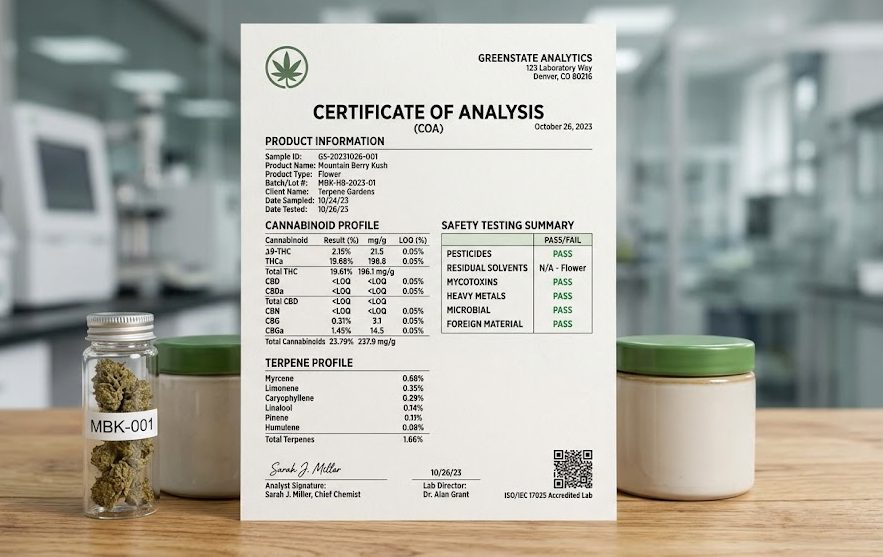
Two quick red flags before you even read the numbers:
- No lab name. If you can’t tell who tested it, treat it as untested.
- No batch or lot number on the COA that matches the product in your hand. A COA for “Batch 0421” doesn’t tell you anything about the jar from Batch 0617.
If both of those check out, keep reading.
Section 1: Cannabinoid potency
This is the part most people skip to. It shows how much of each cannabinoid is in the sample, usually expressed as a percentage by weight.
You’ll typically see:
- THCa — the acidic form of THC that lives in raw flower. It converts to Delta-9 THC when you apply heat (decarboxylation).
- Delta-9 THC — the cannabinoid most people think of when they think “THC.”
- Total THC — usually calculated as
Delta-9 THC + (THCa × 0.877). The 0.877 number accounts for the weight lost during decarboxylation. Total THC is the more honest answer to “how strong is this flower.” - CBD, CBDa, CBG, CBN, etc. — minor cannabinoids that contribute to the overall character of the product.
A flower with 25% THCa but only 0.2% Delta-9 THC is not “weak.” When you spark it, that THCa converts. Read total THC, not just one line.
Section 2: Terpenes
Not every COA includes a terpene panel, but the better ones do. Terpenes are the aromatic compounds responsible for why one strain smells like fuel and another smells like cherry cake. The panel will usually list the top terpenes by percentage — myrcene, limonene, caryophyllene, pinene, linalool, terpinolene, and a handful of others.
You don’t need to memorize them. What you want to see is specific terpene data, not a generic “high in terpenes” claim. If a brand lists actual numbers, they actually tested.
Section 3: Pesticides
This is the section that matters most for your health and gets glossed over most often. A real lab tests for dozens of specific pesticides — typically 60+ compounds depending on the state’s standard.
What you want to see on every line: “Pass” or a value below the action limit. What you don’t want to see: missing pesticides from the panel, or values flagged in red.
If a flower passes its potency test but fails or skips its pesticide screen, the product isn’t safe to consume. Period.
Section 4: Heavy metals
Cannabis is a hyperaccumulator — it pulls metals out of the soil it grows in. A good COA tests for at least the “Big Four”: arsenic, cadmium, lead, and mercury. Each one will show a measured concentration and a pass/fail flag against the regulatory limit.
This matters most in concentrates and vapes, where contaminants get concentrated along with the cannabinoids. If you’re shopping vapes and you can’t find a heavy metals screen, walk away.
Section 5: Microbials
Mold, mildew, bacteria. The lab is looking for things like total yeast and mold, E. coli, salmonella, and Aspergillus species. Aspergillus in particular matters — it’s a mold that can colonize the lungs of immunocompromised people.
Every line should say “Pass” or “Not Detected.” Anything else, don’t buy.
Section 6: Residual solvents
This one only matters if you’re looking at concentrates, vapes, or extracts. When a producer uses butane, ethanol, propane, or CO₂ to extract cannabinoids, trace amounts of those solvents can be left behind. The COA tells you whether what’s left behind is below safe consumption limits.
Flower doesn’t go through extraction, so a flower COA usually won’t have this section. That’s normal.
Section 7: Moisture and water activity
For flower specifically. Too dry and the flower is harsh, brittle, and has lost terpenes. Too wet and you have a mold risk. Water activity (often labeled “aW”) under about 0.65 is the standard ceiling for storage safety. Moisture content usually sits between 9% and 13%.
This is a quality signal as much as a safety one. Well-cured flower lands in the right range and stays there.
Putting it all together
A good COA tells you four things at a glance:
- It exists, it’s real, and it matches the product (lab name, date, batch number).
- The potency is what the label claims (total THC, total CBD, terpene profile).
- It’s clean (pesticides, heavy metals, microbials, solvents all pass).
- It’s properly cured (moisture and water activity in spec).
If any of those four are missing or fudged, the product isn’t really lab-tested — it’s just labeled lab-tested. There’s a difference.
Every batch we release at West Coast Funk has a current COA on our Lab Reports page. Read them. Compare them. Hold every brand you buy from — including us — to the same standard. That’s what testing transparency is actually for.